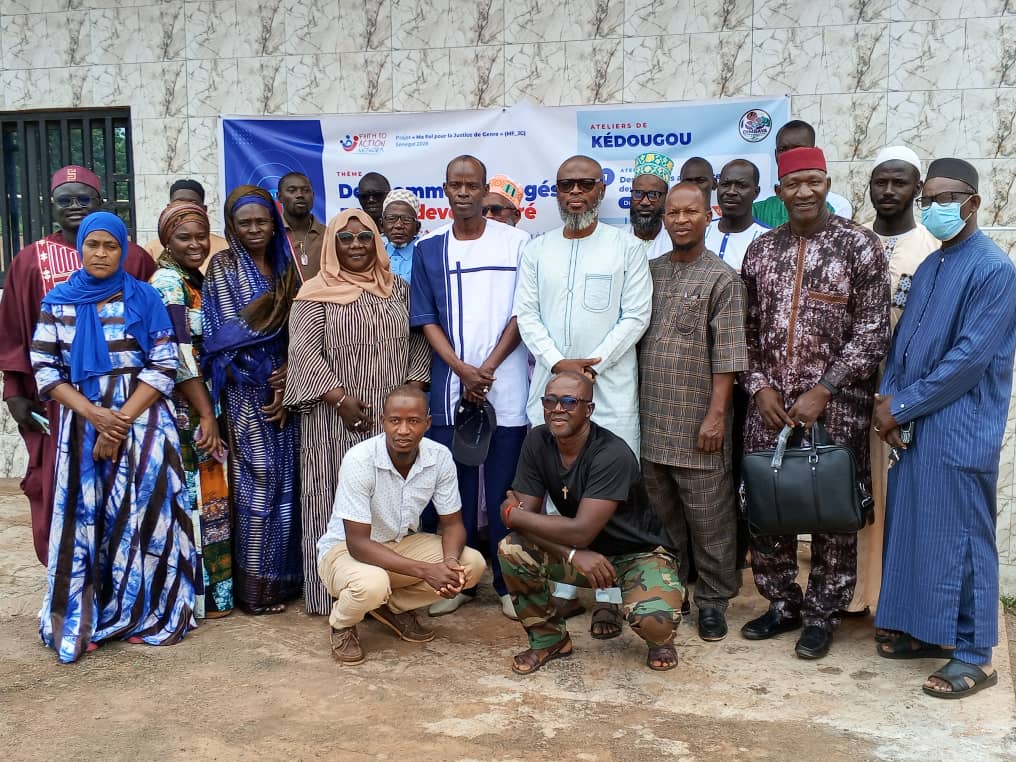
In Kédougou, Senegal, Faith to Action Network and local partner DIMBAYA are working with religious and community leaders to draw on faith as a resource for protecting women and girls, challenging harmful norms and advancing gender justice.
Who do communities turn to when difficult questions arise about family life, relationships, responsibility and right and wrong? Often, religious leaders are among the voices people trust.
That influence carries an important responsibility. When religious leaders speak about dignity, respect and the protection of others, they help shape how these values are understood and practised within their communities. Their voices can also help challenge beliefs and social expectations that contribute to violence against women and girls.
This is why Faith to Action Network, through our Ma Foi pour la Justice de Genre project, is working with faith and community actors in Senegal to strengthen the role of religious leadership in advancing gender justice.
In Kédougou, this work is taking shape through collaboration with the Association Agir pour les Femmes et les Filles de Kédougou (DIMBAYA), bringing together religious and community representatives to explore how social and religious norms can support human rights, non-violence and the dignity of women and girls.
Turning religious values into tools for change
The challenge is not simply to encourage communities to reject violence. It is also to engage with the beliefs, interpretations and social expectations that influence how people understand their responsibilities towards one another. For Faith to Action Network, this means creating opportunities for religious leaders to identify and promote values within their traditions that affirm human dignity, justice and peaceful relationships.
The opening of a laboratory on social and religious norms supportive of human rights, non-violence and gender justice brought together 15 participants came together, including six young people and five representatives of the Christian community. The workshop provided a space to explore how faith-informed messages can contribute to community awareness and the promotion of gender justice.
The Network’s contribution goes beyond convening. By supporting a process that connects religious perspectives with gender expertise, the Network is helping create opportunities for community leaders to translate shared values into practical resources for local engagement. One intended output is the development of four sermon models by each religious group to support awareness-raising on human rights, non-violence and gender justice.
The significance lies in taking the conversation beyond the workshop. Sermons and other faith-based messages can provide religious leaders with practical ways to address these issues in spaces where people already gather, listen and discuss the values that guide their lives.
Why engaging men and faith leaders matters
Preventing violence against women and girls cannot be the responsibility of women and survivors alone. It also requires men, religious leaders and other influential community actors to recognise their role in challenging harmful norms and promoting safer, more respectful relationships.
Through Ma Foi pour la Justice de Genre Faith to Action Network engages men as allies. Our Des Hommes au Service du Devoir Sacré (Men in Service of Sacred Duty) initiative, the Network is encouraging reflection on positive masculinity, shared responsibility and the role men can play in protecting the dignity and rights of women and girls.
The two approaches work together. Social change needs both the willingness to question harmful practices and the ability to offer positive alternatives rooted in values communities already understand. This matters most where religious and cultural traditions carry real influence. Rather than treating faith as separate from gender justice, F2AN works with local actors to explore how faith can be part of the solution.
A wider opportunity for the Network and partners
The experience in Kédougou reflects an approach that holds value beyond a single workshop or location. For Network members and partners, it demonstrates the potential of working with trusted religious leaders to strengthen community-level advocacy and develop messages that respond to local realities.
It also shows the strength of collaboration between faith-based networks and organisations working directly with communities. Faith to Action Network brings its commitment to faith-based action and gender justice, while partners such as DIMBAYA bring local knowledge, relationships and an understanding of the issues their communities face. The resources that result can inform community conversations, strengthen awareness-raising and support continued engagement by religious and community leaders.
For other network members, the approach offers a practical question to consider: how can the religious leaders and community influencers in their own contexts become more active partners in preventing violence and advancing women’s rights? The answer will differ across communities, but the underlying principle remains relevant: lasting change is more likely when the people who shape community beliefs are part of the effort to transform them.
From shared values to lasting change
A workshop or a set of sermon resources cannot, on its own, end violence against women and girls. The longer-term value of this work will depend on how the messages are used, whether leaders follow through on their commitments, and how communities respond. Even so, equipping trusted leaders with practical resources and creating space for reflection and collaboration are important steps towards sustained engagement.
Through its partnership with DIMBAYA and its wider work in Senegal, Faith to Action Network is supporting a vision in which faith leadership actively contributes to human dignity, peaceful communities and gender justice.
When faith leaders use their influence to champion the rights and protection of women and girls, faith becomes more than a shared belief. It becomes a resource for action.