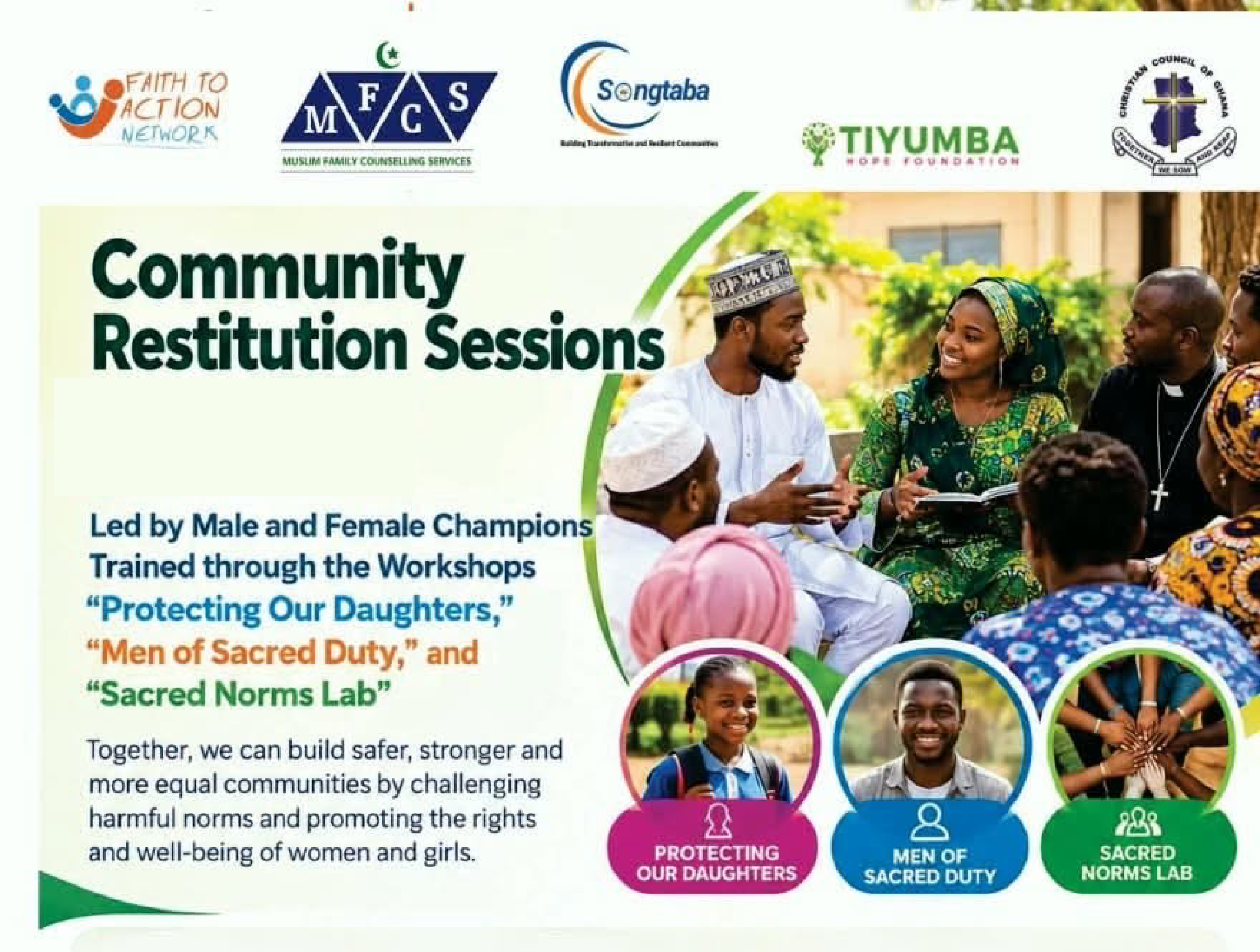
Protecting girls from violence, harmful practices and discrimination requires more than awareness. It calls for families, faith and traditional leaders, and communities to challenge the beliefs and social expectations that allow these harms to persist.
This was the focus of a community restitution session held in Kumasi, Ghana, under the Faith Movement for Gender Justice (FM4J) project, coordinated by Faith to Action Network (F2AN) and implemented with Muslim Family Counselling Services (MFCS).
Bringing together traditional and religious leaders, community workers, educators and other community stakeholders, to reflect on girls’ rights, responsible fatherhood, positive masculinity and the social norms that shape attitudes and behaviour towards girls and women.
Reframing masculinity as care, accountability and protection
A central theme of the dialogue was the role men and boys can play in advancing gender justice. Rather than equating masculinity with dominance, control or rigid gender expectations, the discussions explored how men can demonstrate responsibility through empathy, shared decision-making, non-violent relationships and active involvement in their children’s lives.
Protecting girls is not the responsibility of women or child-protection institutions alone. Men and boys can challenge harmful attitudes among their peers, support girls’ access to education and healthcare, and model respectful relationships at home and in the community.
Responsible fatherhood and mentorship emerged as practical ways to put these principles into action. By supporting their daughters’ aspirations, connecting them with trusted mentors and helping them navigate challenges, fathers and other male role models can contribute to safer and more supportive environments for girls.
The session also explored the proposed Men Talk Truth approach, a space for men to openly talk about emotional intelligence, relationships, mental health and the pressures associated with traditional expectations of masculinity, while reinforcing accountability and non-violence.
Challenging harmful norms while affirming positive values
The discussions also examined how cultural expectations, group identity, religious beliefs and social pressure influence behaviour. Reflecting on sacred and social norms, considerations on why certain practices may persist even when their consequences are harmful arose. Information alone may not be enough to change behaviour when practices are closely tied to community acceptance, belonging or moral identity.
This calls for engaging communities respectfully: affirming positive cultural and faith values while challenging practices that undermine the rights, safety and dignity of girls and women. Compassion, justice, care and responsibility can anchor that change, and faith and traditional leaders are well placed to help communities turn these values into everyday practice.
This approach recognises that sustainable change requires more than condemning harmful practices. It also requires creating opportunities for communities to reconsider expectations, adopt positive alternatives and support those working to change established patterns of behaviour.
Connecting girls’ rights to practical community action
The restitution session moved beyond general discussion to examine barriers affecting girls’ education, health and safety. Participants identified challenges including poverty, school dropout, early and child marriage, harmful practices, gender-based violence, cyberbullying, corporal punishment and limited access to appropriate health and protection services. They also considered the roles of parents, schools, community leaders, government institutions and civil society in responding.
- Education: keeping girls in school, supporting enrolment and attendance, easing financial barriers and countering misconceptions that limit girls’ opportunities.
- Health: better coordination between communities, health facilities and social services, with improved access to adolescent-friendly services, menstrual health information and appropriate referrals.
- Safety and protection: supportive family environments, non-violent parenting, accessible reporting mechanisms and stronger collaboration between child-protection institutions and community stakeholders.
An important lesson emerged: education, health and protection cannot be addressed in isolation. Poverty, violence and harmful practices can affect several aspects of a girl’s life simultaneously. Effective responses must therefore connect services, strengthen referral pathways and address the conditions that leave girls vulnerable.
Empowering girls to shape their own futures
Empowerment goes beyond protection from harm. It means giving girls opportunities to build skills, exercise agency, take part in leadership and make informed decisions about their futures. Suggested areas of support included vocational and technical training, digital literacy, agriculture, entrepreneurship, financial management and life skills.
Men, families and community leaders were encouraged to challenge gender stereotypes, support girls’ ambitions and connect them with trusted mentors and opportunities for participation. Girls should be protected by the adults and institutions around them, and also supported to develop their capabilities and have a say in decisions that affect their lives.
From community dialogue to sustained change
The Kumasi session underscored the need to turn commitments into sustained action. Priorities identified include:
- strengthening father–daughter support and mentorship
- integrating positive masculinity into regular community engagement
- improving access to education and protection services
- expanding legal awareness
- supporting constructive dialogue on social norms
The recommendations also point to the need for clear responsibilities, documented actions and regular follow-up to assess progress.
For FM4J, this approach links community-level engagement to the wider work of advancing gender justice. By bringing together faith and traditional leaders, families, community stakeholders and service providers, the project creates opportunities to address both the immediate barriers girls face and the underlying attitudes that shape their experiences.
Protecting girls ultimately requires action at several levels: accessible services and effective protection systems, supportive families and communities, and sustained efforts to transform harmful social norms.
Faith and traditional leaders can contribute to this change by using their influence to promote dignity, challenge harmful practices and build communities in which every girl can learn, grow and thrive.
Faith to Action Network works with faith actors and partners to advance gender justice, health and community wellbeing. Through initiatives such as FM4J, the network supports engagement that connects shared values with practical action for more just, inclusive and protective communities.